


Rome Top Five - My Next Visit

Updated: Nov 20, 2025

I recently wrote a post about the top five sites to see in Rome when you are in a limited time frame. The sites I selected were accessible virtually all hours and allowed you to see many parts of the city. I specifically shied away from museums because, let's face it, you could get lost in Rome's museums for days!
Here are the top five things I personally plan to see the next time I am in Rome. The parameters are different from my previous post—I am assuming more time for this visit. In addition, I am not revisiting some places I have recently seen. For example, the last time I was in Rome, I spent a lot of time at the Vatican—and the Sistine Chapel may be one of my favorite places in all the world. But that is for a post about the top places to see in Rome, all parameters removed. (Spoiler alert: the Sistine Chapel may be number one!)
For this list, however, these are the top five things I want to see the next time I go to Rome. The criteria are very personal; I have been to some of these places before, and some I have never seen! And all are driven by my own personal interests!
Santa Prassede

I am absolutely obsessed with this church, even though I have never been there. It sits in the shadow of Santa Maria Maggiore and doesn't even have a facade visible from the street.
You enter through a nondescript door into a courtyard. The historical value of this church is immense, and the images look beautiful.
Santa Prassede is what is called a titular church. If that term is unfamiliar, think of a "title" deed - a sign of home ownership. In the early centuries of Christianity, believers gathered in private homes. The titulus was the name of the owner carved above the door. Over time, these "house churches" evolved into the basilicas we see today, retaining the names of the original Roman families—in this case, the family of Pudens, who is mentioned by St. Paul in the Bible (2 Timothy 4:21). Paul writes to Timothy and tells him that Pudens (and others) send their greetings. Saint Praxides (Prassede, in Italian) was the daughter of Pudens, and this church is her home.
The Layer to Look For: This current structure was promoted and built by Pope Paschal I in the early 800s. He is visible in the beautiful mosaic on the apse, inserting himself into the holy group. A fascinating aspect of this is that he has a square halo while the others are shown in their traditional circular halos. A lot of ink has been (reasonably) spilled regarding this square halo. I am accepting, however, of the most obvious and simplest answer: he is still alive, and halos are for those who have passed.
Find my previous discussion of Santa Prassede in the context of Lenten churches here.
Santa Cecilia
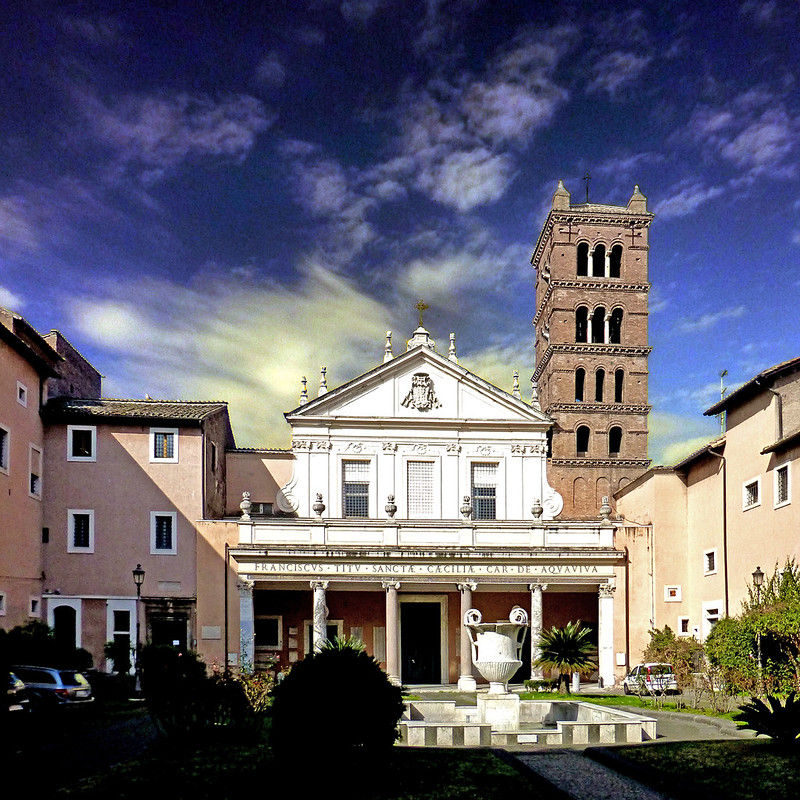
Santa Cecilia is a church in the Trastevere district of Rome. Adding Santa Cecilia to your itinerary will provide an excuse (as if you need one) to visit one of the most welcoming parts of the city. Like Santa Prassede, the church of Santa Cecilia belongs to the same building program of Pope Paschal. Here he brought the relics of Saint Cecilia from the catacombs of Rome into the safety of the city. (I should point out that many relics can be viewed with skepticism: the Relics Trade was alive and well in the Middle Ages. However, Saint Cecilia does not belong among the dubious bones. Admittedly, the story is quite fantastic! Pope Paschal searched for her body, and she came to him in a vision.)
It is the sculpture of her body below the altar that draws my attention. In preparation for the jubilee year of 1600, Pope Clement VIII was preparing the churches for thousands of pilgrims. In the preparatory work done in this church, upon opening the tomb, they discovered the body of Saint Cecilia and immediately sent for the artist Stefano Maderno to memorialize the miraculous discovery. Her body was found as you see her in the sculpture. Notice the twisted form and the cut on the neck from her martyrdom.

Acceptance of the miracle notwithstanding, this is an amazing representation of Counter-Reformation art.
I have previously discussed Santa Cecilia and her relics in a blog post here.
My previous discussion of the church in the context of the church and the Lenten celebration can be found here.
Borghese Gallery

If Baroque sculpture is your thing, there may be no better place in the world than the Borghese Gallery to get your fill. If, on the other hand, you do not know what Baroque sculpture is, I maintain, there may be no better place in the world than the Borghese Gallery to learn about sculpture of this period. The Borghese Gallery contains no less than eight sculptures by this master, including his Apollo and Daphne.
The Elevator Pitch: Baroque sculpture grows out of the Renaissance and is characterized by movement and emotion. Consider Michelangelo's David contrasted with Bernini's David (which is found in the Borghese Gallery). Michelangelo showed the moment before David's fight, the young David staring out into the battlefield contemplating the upcoming battle with the giant, Goliath. Bernini's David is actually in the midst of the battle. His face is full of emotion and effort, and his body is twisted by the act of hurling the stone.
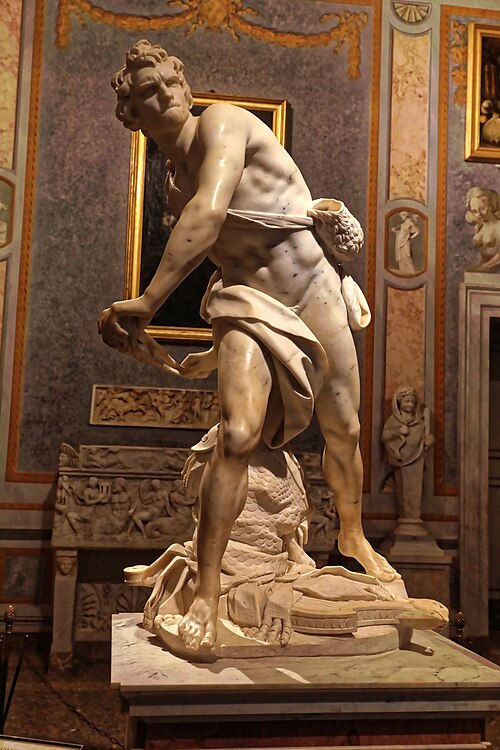
Consider the Borghese Gallery for fantastic, accessible sculpture. In addition, the gallery is surrounded by beautiful gardens, so it is also a nice place to get away from the busy-ness of the city! Pro Tip: You must book tickets for the Borghese Gallery in advance.
Google Street View Link
Capitoline Hill

I have chosen to call this section the "Capitoline Hill" to cover several bases. It is a cheat, I know. But bear with me.
The Capitoline Hill is the most sacred site of ancient Rome, for it held the most important temple, that of Jupiter, Greatest and Best (Jupiter Optimus Maximus). It overlooked the Roman Forum, and even today it commands the best views of the Forum, with the Colosseum in the background.
The Piazza at the top of the Capitoline Hill is beautiful. It was designed by Michelangelo and contains a beautiful pattern in the circular stonework of the Piazza. Your entrance up the gentle slope is guarded by the twin demi-gods, Castor and Pollux, the twins of the constellation Gemini.
Today the buildings at the top are the Palazzo Senatorio, which is the City Hall of modern-day Rome, and two buildings which make up the Capitoline Museums, the Palazzo dei Conservatori and the Palazzo Nuovo. I highly encourage visiting these museums for some magnificent ancient sculptures.
Also on the Capitoline Hill is the Basilica di Santa Maria in Aracoeli (Basilica of St. Mary of the Altar of Heaven). The founding of the church is a fantastic legend, one well worth repeating and embodies the layers of Rome perfectly. The first emperor of Rome, Augustus, the son of Julius Caesar, was told by an ancient Sibyl that there would be a ruler greater than he - and provided him with a vision of Mary and Christ, saying, "Hic est ara Filii Dei", "This is the Altar of the Son of God". And on that spot, Augustus built an altar. The spot was here, in the church of Santa Maria in Aracoeli, and the altar is still there.
The imposing stairs are significant too. The 124 steps were built in 1349 as an offering to the Virgin Mary for letting Rome survive the Black Death. The legend also says that those who climb the stairs on their knees are granted an indulgence. If the stairs are too imposing, you can enter the church by climbing the gentler slope to the Piazza and entering a door on the side!
At one point, the mother of Constantine, Helen, was entombed here. However, her remains were moved to the basilica of Santa Croce in Gerusalemme. (Holy Cross of Jerusalem, fitting for the woman who discovered the true cross.)
Bonus Layer: If you have ever wondered what it would be like to live in the heart of ancient Rome, the remains of an ancient apartment building are at the foot of the stairs. Don't miss this as you pass by! Link.
San Luigi de' Francesi

San Luigi de' Francesi is a French church just a block from the Piazza Navona. Inside are three masterpieces by the artist Caravaggio. The works are centered on St. Matthew: The Calling of Saint Matthew, The Martyrdom of Saint Matthew, and The Inspiration of St. Matthew. They were his first works and reflect the good work of his patron, Cardinal Francesco Maria del Monte. A French Cardinal, Cardinal Matthieu Cointrel - Contarelli, in Italian - left money in his will for his chapel in the church to be decorated. Caravaggio's patron, Cardinal Francesco Maria del Monte, was able to bring this effort to fruition.
Caravaggio presented paintings in a style never before seen in Rome. These specific works of art are considered to be the first paintings of the Baroque period. Heavily influenced by his northern roots, his paintings display a dramatic use of light and dark. And in the Calling of St. Matthew, for example, it is as if the light plays a role, falling on St. Matthew, while others are oblivious.
But it was Caravaggio's use of contemporary people and real-life objects that made him stand out. He is said to have carefully set up the scenes he painted using models, and, in fact, these models are seen in several paintings again and again. In addition, the items he used from real life are not idealized or enhanced. Sometimes fruit is shown spoiled or with bad spots.
It is amazing that you can see all three of these paintings in their original context, in the location for which they were intended, in a church just steps away from the Piazza Navona. As many times as I have walked by this building, I cannot believe I have never stopped in.
--
Of the places above, the only one I have seen before is the Borghese Gallery, and that was decades ago. I am eager to return to Rome and see these top five places on my list. Would you want to visit these sites? Have you already seen some of them?
-----
P.S. Ever get confused by the inscriptions you see in Rome?
I created a free, 1-page "5-Minute Decoder" that unlocks 90% of the phrases you'll see on monuments. It's the perfect tool to go from a tourist to an insider.


Comments