


San Marco - Monday, Third Week of Lent

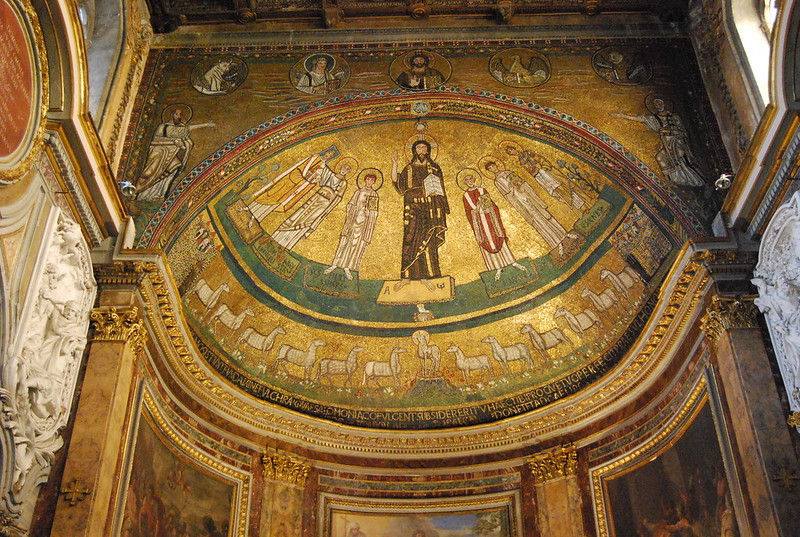
San Marco is among he oldest churches in Rome, and you may be surprised to hear that you have passed by it. If you have stood at the Wedding Cake and looked out at the Piazza Venezia, you have seen this church - without even noticing it! It shares a wall with the Palazzo Venezia, the headquarters of Mussolini's government, and faces the Wedding Cake Monument. The Piazza Venezia and the open space in front of the church of San Marco create a large open space together in the center of Rome.
The Piazza Venezia is so named because it was a name when the palace along the side was the embassy for the Republic of Venice. This connection to Venice is related to the church of San Marco, for Saint Mark is the patron saint of Venice, and his remains are to be found in the Basilica of San Marco in the heart of Venice. The today is the national church of Venice in Rome, which means that it serves the needs of the Venetian community in particular.
The Basilica di San Marco church was founded in 336 by Pope Mark. Saint Mark the evangelist, author of the Gospel of St. Mark is said to have stayed at this spot when traveling through Rome, and the basilica commemorates his visit.
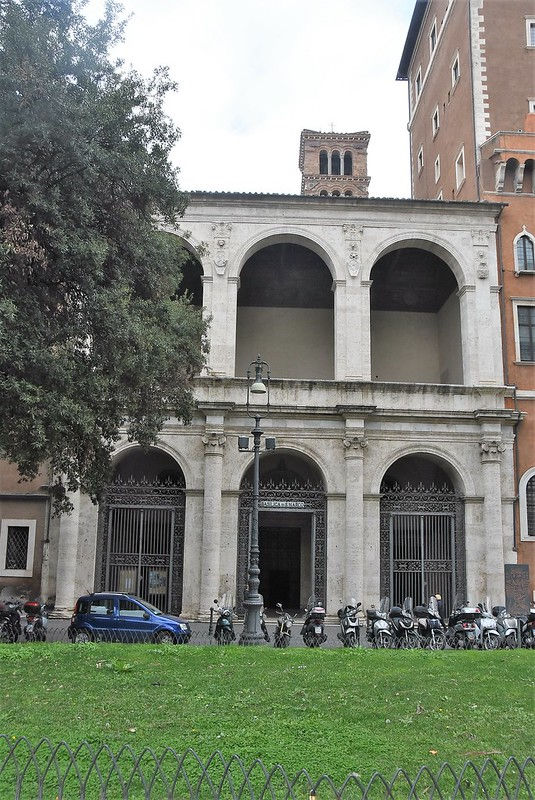
You can be forgiven for missing the Chiesa di San Marco. The trees in the piazza out front, while providing welcome shade in the summer, block the entrance to the church. However, even if the trees were not there, there is only a small sign on the front designating the church. There is no visible facade, but only three arches topped by three equal-sized arches. In Rome, arches are plentiful, and do not single this building out as a church.
These Renaissance arches, made of local travertine marble with their engaged Corinthian Columns create a portico before the entrance proper to the church. In this way, they function somewhat as a facade. In Italian church architecture, the purpose of the facade of a church is to prepare the visitor for what appears inside the church. Here, in San Marco, the three arches prepare the visitor for the three aisles of the basilica beyond.
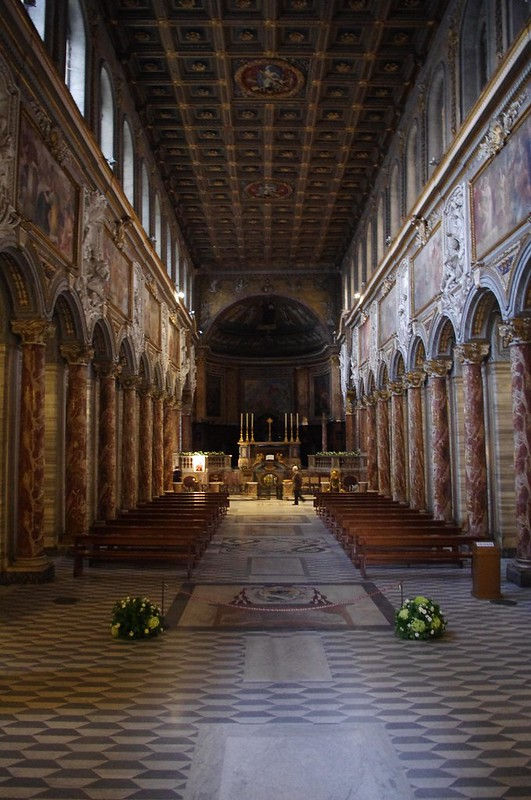
The interior of the church is beautiful. As is often the case with older churches, such as we saw with San Vitale, the floor level is lower than the current level of the city. This church has been regularly updated, and the interior expresses the opulence of a Baroque church. Peeking through the older refinements, let's consider a couple of things about the interior.
Look up and notice the coffered wooden ceiling. It seems to float on those windows that line this upper story. The ceiling dates from the mid-1400s, placing it squarely in the Renaissance.
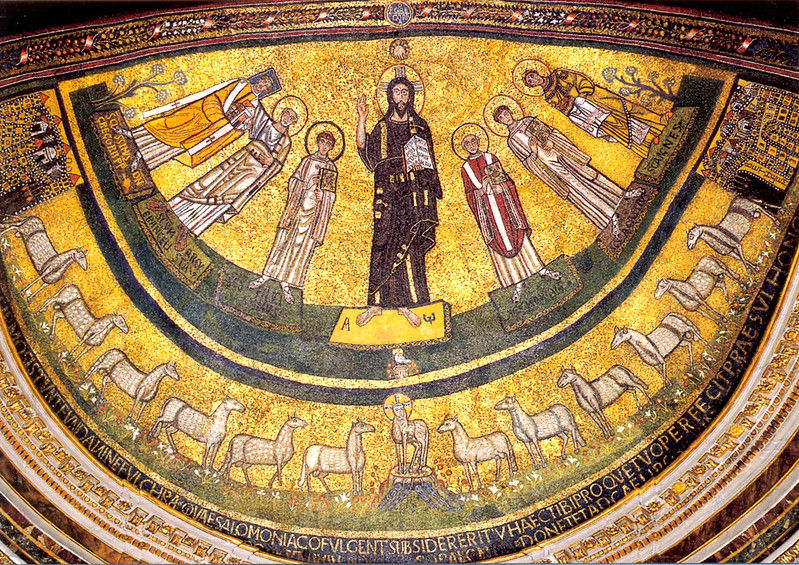
Moving further down the nave, look at the beautiful mosaic in the apse. Pope Gregory, responsible for much of the restoration and rebuilding in the 800s, presents a model of the church in the presence of St. Mark the Evangelist, and in the mosaic, the pope bears a square halo, used so often to show that he was alive when the mosaic was completed.
In a curious bit of history - that has no explanation whatsoever - this basilica holds the marble epitaph or grave marker of Vanozza dei Cattanei. You may not recognize the name, but you have likely hard of the family. (Showtime created a whole series on the family!) Vanozza is the mother of the Borgia children whose father is Rodrigo de Borgia, also known as Pope Alexander VI. The two of them had four children, Cesare, Giovanni, Lucrezia, and Goffredo, and history (with reason) knows them more for their cruelty than any other accomplishments. How or why her marker came here from the church where she is buried in Piazza del Popolo is unknown. It is simply a curious tidbit of history.
The Basilica di San Marco is a curious church hidden in the busiest piazza in the center of Rome!
--
-----
P.S. Ever get confused by the inscriptions you see in Rome?
I created a free, 1-page "5-Minute Decoder" that unlocks 90% of the phrases you'll see on monuments. It's the perfect tool to go from a tourist to an insider.


Comments